
You don’t live next to the front line, but Russia targeted your village’s heating infrastructure last week. Frost dusts the windows of your apartment. Heat rises, but even eight floors up, the effect of physics is marginal. You have one space heater, but the electricity could be cut at any moment.
The entirety of your life takes place in one room, under a heap of blankets. In the spring and summer, it will be easier.
But that’s not your only problem.
You aren’t eating enough. Your local ATB grocery carries everything you need. Meat is more expensive than vegetables, and you eat very little protein. Eating beef or chicken feels like a luxury.

It could be worse, you say to yourself. The Defenders at the front are in trenches. Your best friend, now living in Kyiv, lost her home and children. You’re one of the lucky ones. These thoughts help you survive, but they are a poor substitute for little food and no heating.
The fingers of war stretch out further than most of us in the United States realize. From deadly bombings in Dnipro or Sumy to disrupted supply lines and economic strain, everyone suffers.
The war will end one day. But keeping everyone well-fed is critical to preventing tragic and expensive disasters like malnutrition, famine, and mass starvation. These events affect generations, not individuals.
On a basic level, when you eat well, you have the foundation to solve all of the cascading problem life throws at you. You do more than survive war and disaster, you can thrive. You do not pass on the physical traumas of hunger to your children, grandchildren, and great-grandchildren.
We can’t stop the war, or fix infrastructure. We aren’t trained for that. But as a disaster aid nonprofit, we understand food.
A closer look at food insecurity in Ukraine
According to the United Nation’s Food Security Cluster in Ukraine, 5 million people are food insecure. The percentage of households in need rises the further East your travel—essentially, closer to the front line.
There are multiple amazing programs throughout the country that attempt to fill the gap. However, less than 2 million people were reached between January and June 2025.
And there’s a good reason: Feeding people is expensive.
Earlier in the year, we spoke with a local nonprofit near Kharkiv looking for 1,200 ready-made-meals (MRE) to feed Defenders and an orphanage. We looked up the numbers. The cost was a staggering $100,000 to ship 1,200 MREs from Europe to Ukraine. How long would they last—a month for 20 people, assuming two meals per person? That’s absurd.
Even for multi-million dollar NGOs, this approach seemed cost-prohibitive in the long-term.
There had to be a more another way to help feed more people, not just once, but throughout the war.
Cost-effective food aid: Why chickens
An MRE or any other food item can only be used once. And it is the same price every-time.
But our team knew from experience that access to livestock changes the game. And while village populations typically decline overtime, and they had been in Ukraine during the war, many families choose to leave the city for the safety of the country. We drove through these villages, and we noticed an absence of thing: Chickens.
Egg-laying chickens alone are an excellent source of constant protein. Every month, you get around 28 eggs per hens. Multiple that by 20, minimum, and you have enough for a family of four to eat four eggs a day. That’s almost half of an adult’s required daily protein intake! It’s also 100% of your fat intake and it accounts for at least a tenth of daily calories.
But families save serious money, too. The equivalent cost of eggs for this family of four is 11% of a monthly salary.
Basically, we realized that providing hens to rural households and displaced persons centers offers a cost-effective way to feed people not once, but every month.
You may wonder, why won’t Ukrainians simply buy chickens themselves?
Hens in Ukraine are expensive—more than you think
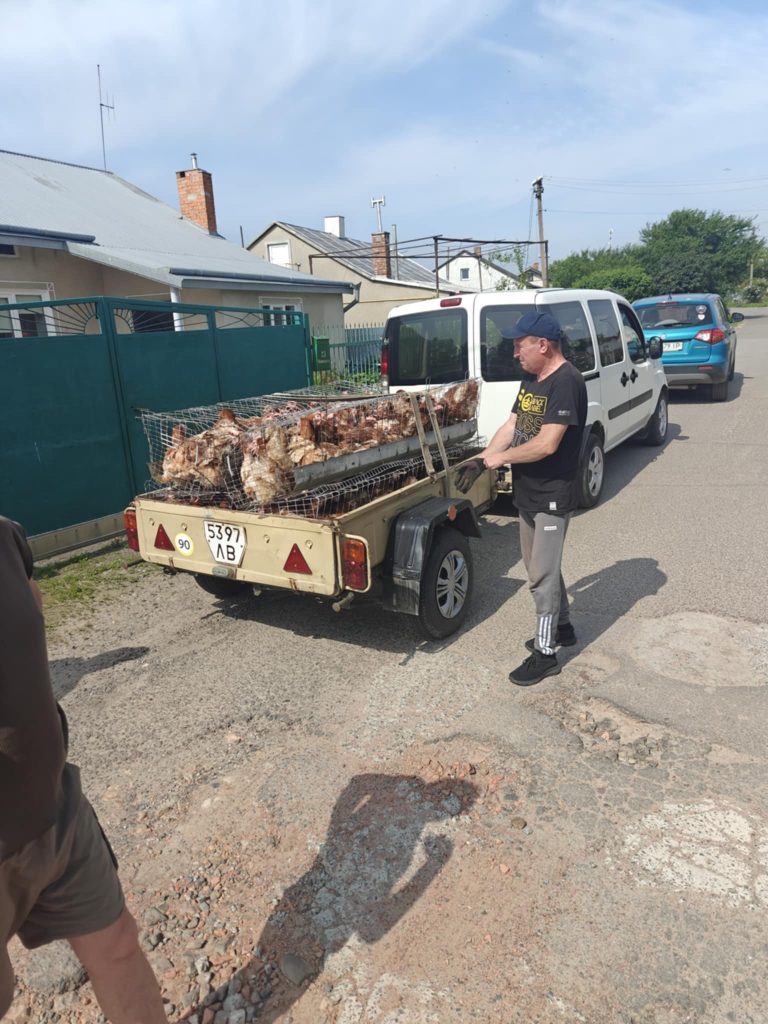
directly from farmers.
Buying healthy hens is expensive. In the US where you can get 3 chicks at your local Tractor Supply for $2. Meanwhile, the cost of a single hen in Ukraine is $5. And sales of the best birds are seasonal and inconsistent in rural markets.
When we called local providers, getting 200 egg-layers was a challenge, even in the West. Farmers typically sell a small quality high-quality hens in the spring. By the end of the year, local buyers wonder if the remaining egg-layers are defective or old—and would rather wait.
But that’s not the only problem. There are large producers of chicken meat and hens. But they largely focus on exporting chicken meat. Chicken is still the most affordable meat on the market, but with high inflation, unemployment, and weak supply chains in the East, many can’t afford it.
The war has affected the poultry industry, too. For example, prior to the war, most producers were located in Eastern Ukrainian, particularly Cherkasy and Dnipropetrovsk. Now, producers are migrating west to reduce risks from the war. This will likely increase the cost of chicken and eggs in Eastern Ukraine and further extend food deserts.
Affordable hens and smoked chicken: Project Henrietta
Project Henrietta seeks to solve, or at least work around, some of these issues and get food to more people.
In the beginning, we were purchasing hens $5 per hen for households. We quickly realized that this would hinder our ability to help our people. Not only did we need to reduce costs, but we couldn’t maintain a constant supply of hens. The rural markets just don’t work that way.
So, we developed a plan to increase consistency, lower cost, and help us get both hens and smoked meats to families: Henrietta Hubs.
We are building two hubs in Ukraine with our partners. The Phoenix, a displaced persons shelter, will use our hub to support their residents and raise excess to deliver hens to families. The Hlyboki Balyky Ecological Research Station in central Ukraine will use the hens as an educational opportunity for local farmers and homesteads while also supplying us with hens for delivery.
These hubs are the beginning of a logistics network of small homesteads. Recipients, many of whom are veterans or have family in the war, can choose to help us smoke chicken meat to send to the front and to urban populations near the front-line.
Basically: While you need to live in a village to have chickens, we have a roadmap to connect hen recipients to other food initiatives.
So, outside of supporting our hubs and transporting hens/smoked chickens, overhead is low.
At the same time, all resources remain in Ukrainian hands. These families can choose to continue raising hens after the war, create a business, or sell off their assets. What matters now is supporting our Ukrainian neighbors in staying fed and stable until a lasting-peace is achieved.
And you can drive this project forward.